Midterm Exam
(You may leave any complete question
or questions blank for 20%)
1. Your employer, the Prudent Bank and Trust Co., is being sued by
GetRichQuick.com, an online investment company that bought a
substantial quantity of mortgage based securities from PBT and lost
quite a lot of money on them.
After a preliminary investigation you conclude that without substantial
evidence of misrepresentation they have zero chance of prevailing.
Unfortunately, several of your employees engaged in extensive email
correspondence with GRQ employees prior to the transactions, and there
is some risk, you think about 20%, that somewhere in that email there
is something that could be interpreted by a court as misrepresentation,
raising their chance of prevailing to 10%. If they do prevail you
expect them to be awarded $10,000,000. Hiring someone to do a careful
search through the accumulated email will cost $50,000. GRQ has offered
to accept $250,000 to settle their claims and you believe this is
their final offer. You estimate your trial costs if the case is not
settled at $100,000.
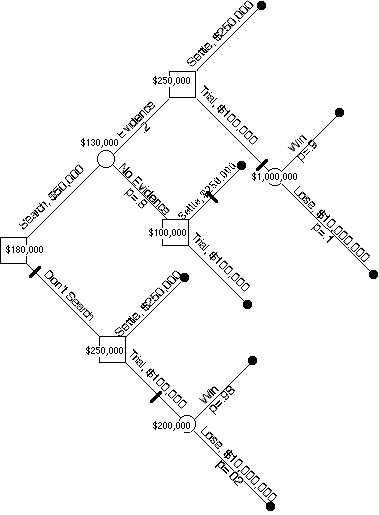
Draw a decision theory diagram for the problem on the back of page 3
and use it to decide what to do with regard to deciding both whether to
search and whether to accept the settlement offer or go to trial.
Explain if necessary. (10 points)
The first choice is whether to
search or not.
If you don't search, the next
choice is to settle ($250,000 cost) or go to trial ($100,000). If you
go to trial there is a .02 chance of losing (.2 chance there is
evidence x .1 chance if there is evidence that you will lose--I could
have shown this as two separate die rolls but didn't bother) and a .98
chance of winning. Winning costs you nothing, losing costs $10,000,000,
so .02 chance of losing costs $200,000. That plus the $100,000 trial
cost is more than the cost of settling, so if you don't search you
settle, making the cost of that branch $250,000
If you do search, you find
evidence (p=.2) or don't (p=.8). If you do you can settle for $250,000
or go to trial. Trial costs $100,000, a .1 chance of losing costs
$1,000,000, so total cost is $1,100,000, so if there is evidence you
settle. If you don't find evidence trial costs you only the $100,000
trial cost, since you are sure to win, and that's lower than the
$250,000 settlement cost. So if you don't find evidence you go to trial.
So you have a .2 chance of finding
evidence, cost $250,000, a .8 chance of not finding it, cost $100,000,
total expected cost $130,000. Add to that the $50,000 search cost and
the expected cost if you look for the evidence is $180,000, which is
less than the expected cost if you don't. So you look for evidence,
settle if you find it, go to trial if you don't.
2. Consider the previous problem from the standpoint of Lenny
Litigator, GRQ’s attorney, who agrees with you about the facts of the
situation. Lenny is deciding what his settlement demand should be; his
costs if the case goes to trial are $50,000.
A. Use game theory—specifically, subgame perfect equilibrium—to decide
whether he (and his client) are better off demanding $250,000 or
$100,000. Assume all parties are risk neutral. Draw any necessary
diagrams on the back of page 2.
We have already analyzed what
happens if he demands $250,000. The defendants pays for a search,
settles if there is evidence (p=.2), goes to trial if there isn't
(p=.8). From Lenny's standpoint that means a .2 chance of $250,000 in
settlement, a .8 chance of paying $50,000 for a trial and getting
nothing, for an expected return of $50,000-$40,000 = $10,000
If he demands $100,000, settling
is cheaper than search+either settling or paying for a trial, so the
defendant will settle, giving Lenny $100,000.
So better to demand $100,000.
B. Can you think of any reason why the assumptions of subgame perfect
equilibrium might not hold in this situation? (10
points)
The defendant might want to go to
trial even with the lower demand, in order to lower the plaintiff's
return and so discourage future plaintiffs.
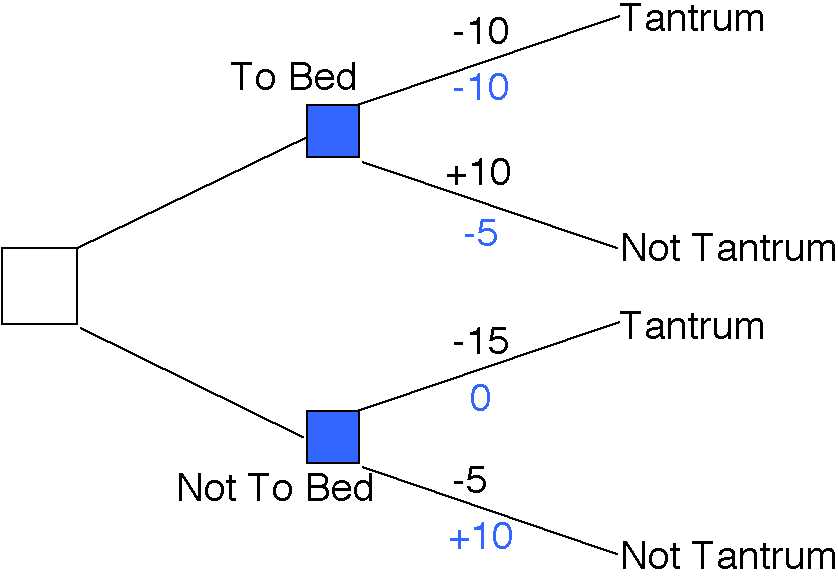
3. The diagram shows the "put to bed/tantrum" game discussed in class;
the parent's payoffs are black, the child's blue. The same game can
also be described using a strategy matrix, shown below. Define the
strategies and fill in the cells with the payoffs to each player.
ParentStrat1: Put to bed
ParentStrat2: Don't put to bed
(let stay up)
ChildStrat1: Never throw a
tantrum, whether or not put to bed
ChildStrat2: Always throw a
tantrum, whether or not put to bed
ChildStrat3: Throw a tantrum only
if put to bed
ChildStrat4: Throw a tantrum only
if not put to bed
(5 points)
|
Child's Strategies
|
ChildStrat1
|
ChildStrat2
|
ChildStrat3
|
ChildStrat4
|
Parent's
Strategies
|
ParentStrat1
|
(10,-5)
|
(-10,-10)
|
(-10,-10)
|
(10,-5)
|
ParentStrat2
|
(-5,10)
|
(-15,0)
|
(-5,10)
|
(-15,0)
|
4. The Law School has decided to offer every graduating student a
free
Bar prep course in the hope of raising its Bar passage rate. It is
negotiating with PaBar, a small but well respected firm that produces
such courses. The central issue being considered is how to determine
how much PaBar is paid. Should it be based on the number of students
who choose to take the course, the number of student hours spent in
class, the number of students who, after taking the course, pass the
Bar Exam on their first try, or the percentage of graduating students
(including those who do not take the course) who pass the Exam on their
first try?
A second issue is where the courses are to be given. Should PaBar find
its own facilities, and if so who should pay for them? Alternatively,
should PaBar be offered the use of university classrooms, if available,
and on what terms?
Briefly describe several possible contracts, the problems each might
raise and how they should be dealt with, and recommend the one you
think best. You may use the back of page 1. (15
points)
Compensation: With cost plus,
PaBar's only incentive to keep costs down is the hope of future
business. Since it is presumably running some other courses, there
might be problems measuring cost--PaBar would have an incentive to try
to allocate as many costs as possible to its university
courses--overpay teachers there with the understanding that they would
work for lower wages in its other courses, for instance.
Fixed payment has two problems.
One is that Paybar, as a small firm, may not want to bear the risk of
higher costs. But the only element that one would expect to be
unpredictable is the number of students, and the fixed payment could be
made on a per student basis.
The other problem is the incentive
to lower quality in order to save money. Which brings us to …
Giving Pabar an incentive to do a
good job. The simplest way would be to make the compensation in part
depend on how many students pass the bar--not entirely because PaBar is
probably risk averse. This raises some further problems, however.
If the bonus is per student who
passes, PaBar has an incentive to try to encourage students likely to
pass to enroll and to discourage students unlikely to pass--still more
so if it's based on the percentage of students who taking the PaBar
course who pass the bar. What the school wants is to maximize the
fraction (or equivalently the total number) of its graduating students
who pass. So it could base the bonus on that number, counting both
students who have and students who have not enrolled in PaBar. That way
Pabar has no incentive to try to cherry pick the students who would
pass anyway. Instead it will invest its efforts in whatever gives the
greatest increase in bar passage rate per dollar spent.
So far as facilities, the school,
having agreed on a fixed rate per student plus bonus compensation plan,
should offer its facilities to PaBar at cost, and leave it free to rent
outside facilities if that costs less.
Contract 1: Cost plus a bonus for
each student who enrolls in PaBar. No incentive to keep cost down, and
an incentive to try to attract students whether or not the added course
will increase their chance of passage.
Contract 2: Per student payment,
bonus based on percent of students taking the course who pass.
Incentive to cherry pick the students who would probably pass anyway.
Contract 3. Per student payment,
bonus based on total number of graduating students who pass (meaning in
each case pass at the first try), including those who didn't enroll.
Best alternative of the three for reasons sketched above.
A further point one student made
was that if the contract does not provide an adequate incentive to
maintain quality, the law school might want to monitor the teaching in
an attempt to measure quality--although it's not clear what the school
can do if it isn't satisfied.
[This question didn't have a single right answer--what I wanted to see
was how well you could analyze the problem.]
5. High-Brow Decorators sells furnishings for fancy offices,
specializing in an old English library look.. One of its most popular
furnishings is a "wall" of 1000 old books. In its inventory, the
company has three "walls" of old books. The first it purchased for
$100; the next it purchased for $300 and the third it purchased for
$500. The price of old books varies based on the scrap value of used
books at the time of purchase. One of High-Brow's customers – Joan
Lawyer – who just became a partner in a fancy law firm orders one wall
of books for $2000; the firm delivers the books and bills Joan.
Show the T-accounts for the three purchases and the sale. What is the
combined result of the series of transactions on the firm’s total
assets, liability and equity?
Assets go up by $1900 (FIFO) or
$1500 (FIFO). Liability unaffected. Equity up by the same amount as
assets.
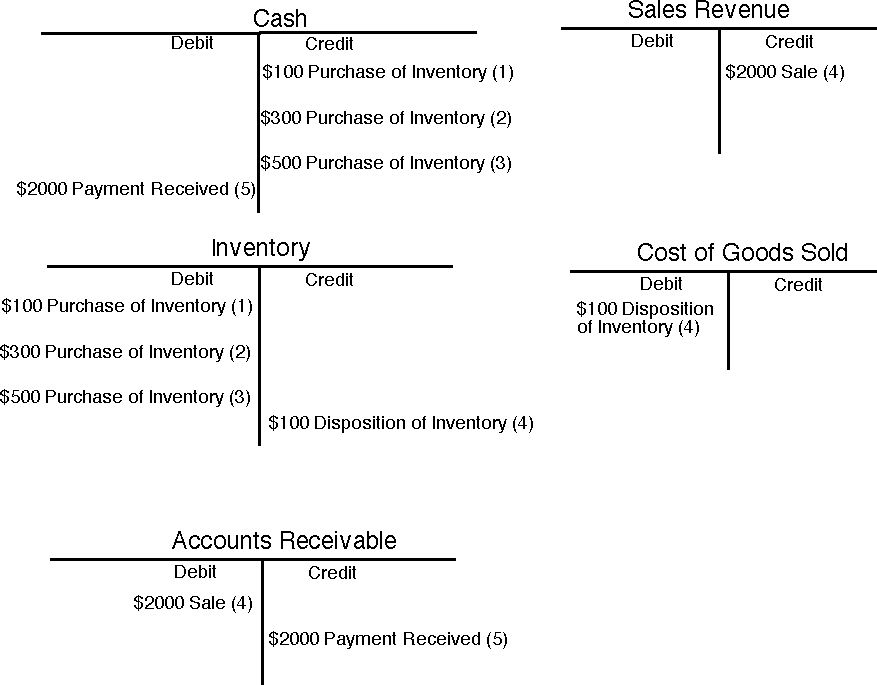
Draw a final set of T-accounts to show what happens when Joan pays
the
bill. How does that affect the firm’s total assets, liabilities and
equity?
(5) in the T-accounts above.
Assets, liabilities and equity are unchanged--one asset (account
receivable) has been converted into another (cash).
State any assumptions you are making about the firm’s accounting
practices. (10 points)
The T Accounts assume FIFO--with
LIFO item 4 would be $500.